
Filter by
794 results found
-
Ecosystem-based adaptation: a win–win formula for sustainability in a warming world?
Many national and international environmental agreements acknowledge that the impoverishment of ecosystems is limiting the world’s capacity to adapt to climate change and that ecosystem-based adaptation (EbA) approaches should be harnessed as a priority. -
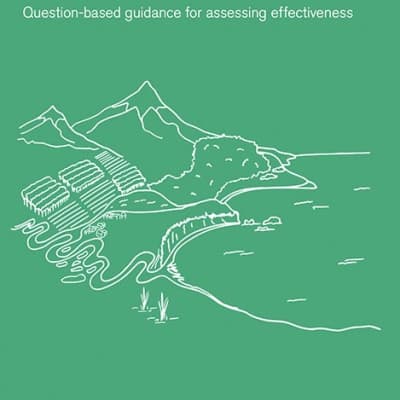
Ecosystem-based adaptation: question-based guidance for assessing effectiveness
This booklet sets out guidance for assessing the effectiveness of an ecosystem-based approach to climate change adaptation. It describes a process, based around asking a detailed set of questions, that can be used by project managers and researchers. -
How effective are Nature-based Solutions to climate change adaptation
This breif discusses how nature-based solutions can help people adapt to the effects of change and disasters whilst slowing warming and protecting biodiversity, with many more positive consequences, fewer risks and lower costs than engineering-based approaches. -
Nature-based solutions: delivering national-level adaptation and global goals
“Many of the world’s vital natural ecosystems, and the communities reliant on them, are vulnerable to climate change. But there is increasing recognition that ecosystems — if sustainably restored and protected — can also form a strong line of defence against the direct impacts of climate change and support human adaptation over the long term. […] -
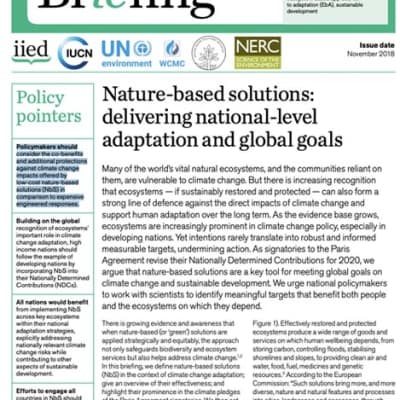
Nature-based solutions: delivering national-level adaptation and global goals
Policymakers should consider the co-benefits and additional protections against climate change impacts offered by low-cost nature-based solutions (NbS) in comparison to expensive engineered responses. -
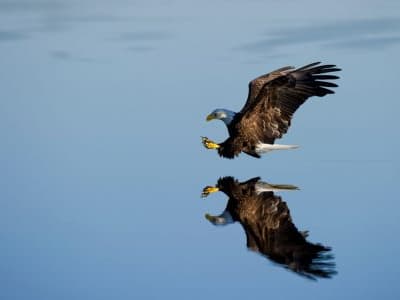
A rallying cry for nature’s role in tackling climate change
China and New Zealand called on leaders in government and business to endorse nature-based solutions. The Nature-based Solutions for Climate Manifesto aims to attract political momentum, highlight the need for funding, and encourage the integration of nature in all aspects of planning and decision making for sustainable development. -

Jen M. Lucey
About Jennifer Lucey is the Deputy Director of the Nature-based Solutions Initiative and a Senior Researcher specializing in biodiversity and sustainable agriculture at the Smith School for Enterprise and the Environment (Department of Geography) at the University of Oxford. Her impact-driven research aims to find and refine nature-based solutions for transforming agricultural landscapes to support […] -

Sustain-Cocoa: Sustainable sourcing policies for biodiversity protection, climate mitigation, and improved livelihoods in the cocoa sector
The conversion and degradation of tropical forests have multiple negative socio- environmental impacts. Conversely, their restoration, including enhancing tree cover on already cleared farmland, is a powerful nature-based solution to climate mitigation and adaptation, with potentially large biodiversity and rural livelihood co-benefits. A major driver of forest loss and degradation in the tropics is the […] -

Nature-based solutions for resilient infrastructure systems in Jamaica, Bangladesh and the Maldives
This project investigates the benefits and costs of NbS in enhancing the resilience of infrastructure systems, including water supplies, renewable energy, transport systems and flood protection. It uses geospatial tools to inform the prioritization of NbS and their deployment where they will yield the greatest benefits for infrastructure resilience, biodiversity, livelihoods and carbon sequestration. -

Cécile A.J. Girardin
Interests and expertise My research focuses on the potential for Nature-based Solutions to respond to climate change. I am an expert on the ecosystem functioning and carbon dynamics of tropical forests across the globe, and their response to a rapidly changing climate. I am a scientist and an artist. As an artist, I have produced […] -

Adam Blanchflower
Interests and expertise I am a fourth-year Biology (MBiol) student at the University of Oxford, completing my Master’s research under the supervision of Dr Daniel Hending. My project focuses on assessing how forest fragmentation affects nocturnal lemur populations in Sahamalaza-Iles Radama National Park, Madagascar, using passive acoustic monitoring (PAM). This approach offers a novel way […] -

Understanding the value and limits of NbS to address climate change and other development challenges in the Philippines
This research provides a country-specific analysis of nature-based solutions (NbS) for addressing societal challenges in the Global South, with a focus on the Philippines. This project examines the potential of NbS to support climate change adaptation, identifying intervention types, outcomes, priorities, and the factors that hinder or enable NbS. A central question guides this work: […] -

Kathryn Brown
-

Conserving sharks and rays in the global south
This project assesses the vulnerability of shark species and sustainability of elasmobranch fishery against contemporary fishing pressures. This information is being integrated into the National Plan of Action for Sharks and rays-Bangladesh as part of the Food and Agriculture Organization’s International Plan of Action for Conservation and Management of Sharks. The research explores the ecological, […] -

Joe Boyle
Interests and expertise I am supporting NbSI projects on human values of nature and how to work in harmony with ecologies across society. This includes theoretical work on how social transformations can work in symbiosis, and gathering case studies of nature-based solutions from local, traditional, and Indigenous knowledges. Background After graduating from a BSc in […] -

Addressing climate vulnerability with nature-based solutions in Bangladesh
Bangladesh, like many lower income countries, is exceptionally vulnerable to increased climate risks, exacerbated by environmental degradation and socio-economic challenges including the COVID-19 pandemic. Nature-based solutions could provide cost-effective options to address these challenges but policymakers lack evidence on their effectiveness. To address this, we produced a comprehensive synthesis of evidence on the effectiveness of […] -

Zoe Brown
Interests and expertise I am broadly interested in nature-based solutions in their relevance to climate adaptation, socio-ecological resilience, and food systems, specifically within the context of small island developing states (SIDS). My doctoral research will focus on understanding the effectiveness of nature-based solutions for climate change adaptation in SIDS. Background I was raised in The […] -

Biodiversity outcomes of nature-based solutions for adaptation in the Tropical Andes
This project explores the outcomes of Nature-based Solutions for Adaptation upon biodiversity in the Tropical Andean region of South America. -

Rachel Cavanagh
Interests and expertise Information coming soon. Background Information coming soon. -

Synergies and trade-offs between net zero policies and biodiversity conservation in Brazil
This project develops and deploys economic landuse modelling to understand the synergies and trade-offs between net zero policies and biodiversity conservation, including the role of nature-based solutions, in climate mitigation efforts, with a particular focus on Brazil. The project also seeks to understand the impacts on ecosystems of different trade policies and supply chain agreements. -

Investigating the biodiversity, social and sustainable development outcomes of achieving net-zero in the UK
This project explores the climatic, environmental and wider consequences of greenhouse gas removal (GGR) methods. GGR is expected to form an integral part in achieving a climatically sustainable future, and features prominently (sometimes at enormous scale) in domestic and international pathways that successfully reach ‘net-zero’ emissions. The diversity of different practices and relative lack of […] -

Alexandre Chausson
Alex is now a senior associate, having moved to WWF UK in November 2022, but will continue to collaborate with the NbSI. Interests and expertise I managed and collaborated on the delivery of research and knowledge-exchange outputs. This included conducting applied research for policy on Nature-based Solutions, with a focus on climate change adaptation, development, […] -

Susan Chomba
Susan is the Director of Vital Landscapes at the World Resources Institute (WRI) Africa, based in Nairobi. She leads WRI’s work on forest protection and conservation, food systems transformation and governance in Africa. She is a scientist with extensive research and development experience in Africa. Susan is a global ambassador for the Race to zero […] -

Scaling-up nature-based solutions in the UK
An 18 month research ‘Sprint’ - part of the Agile Initiative at the Oxford Martin School - worked with stakeholders to identify and tackle key cultural, scientific and governance barriers to the implementation of high-quality NbS in the UK -

Nature-based solutions to address climate risks in the UK
We are investigating the potential of NbS to support climate change adaptation in the UK.