Outputs
Below is a collection of Nature-based Solutions Initiative outputs from our team or closely related partners. For academic papers solely on Nature-based Solutions see our bibliography.
94 results found
-

Nature-based solutions are critical for putting Brazil on track towards net-zero emissions by 2050
May 2023Most of the world's nations (around 130) have committed to reaching net-zero carbon dioxide or greenhouse gas (GHG) emissions by 2050, yet robust policies rarely under- pin these ambitions. To investigate whether existing and expected national policies will allow Brazil to meet its net-zero GHG emissions pledge by 2050, we applied a de- tailed regional integrated assessment modelling approach.
Academic Publication -

Cocoa plantations are associated with deforestation in Côte d’Ivoire and Ghana
May 2023re we combine cocoa plantation data with publicly available satellite imagery in a deep learning framework and create high-resolution maps of cocoa plantations for Côte d’Ivoire and Ghana, validated in situ
Academic Publication -

Going beyond market-based mechanisms to finance nature-based solutions and foster sustainable futures
April 2023We draw on recent research on the effectiveness, governance, and practice of NbS to highlight key limitations and pitfalls of a narrow focus on natural capital markets to finance their scaling up.
Academic Publication -

A decentralized approach to model national and global food and land use systems
March 2023We have built a flexible, collaborative modeling framework to foster the development of national pathways by local research teams and their integration up to global scale. Local researchers independently customize national models to explore mid-century pathways of the food and land use system transformation in collaboration with stakeholders.
Academic Publication -
Nature-based Infrastructure: How natural infrastructure solutions can address sustainable development challenges and the triple planetary crisis
March 2023This report analyzes the potential contribution of nature-based infrastructure (NbI) solutions to the SDGs, Paris Agreement, and Global Biodiversity Framework (GBF). It identifies five ‘functions’ through which nature can deliver infrastructure-related benefits, and finds that NbI in eight sectors can influence up to 79% of SDG targets across all 17 goals, which rises to 95% when NbI is combined with built infrastructure. For any individual sector alone, the deployment of NbI in conjunction with built infrastructure can influence anywhere from 24%-47% more SDG targets than built infrastructure alone in that sector, largely due to the multiple additional benefits derived from NbI.
Report/Brief -

Embedding nature recovery in the Levelling-up and Regeneration Bill
March 2023The evidence presented here shows the importance of providing more accessible nature-rich green spaces that benefits everyone, as a core part of levelling-up and regeneration.
Report/Brief -

Nature-based solutions are key for meeting Brazil’s climate goals and supporting the economy
November 2022There is a large mismatch between current climate ambition and climate policy implementation in Brazil, driven by a failure to curb the conversion of carbon rich biodiverse native ecosystems (the single largest source of emissions in the country) mainly for agriculture. N
Report/Brief -

Climate resilience and the human-water dynamics. The case of tomato production in Morocco
November 2022Building on system dynamics modelling tools, we aim to improve the understanding of the long-term dynamic behavior of water management and to explore plausible policy scenarios necessary for sustainable and resilient water resource management and agricultural development.
Academic Publication -

How can diverse national food and land-use priorities be reconciled with global sustainability targets? Lessons from the FABLE initiative
October 2022Here, we present a collaborative approach developed with the FABLE—Food, Agriculture, Biodiversity, Land, and Energy—Consortium to reconcile both global and national elements for developing national food and land-use system pathways.
Academic Publication -

The Role of Nature-Based Solutions in Supporting Social-Ecological Resilience for Climate Change Adaptation
September 2022Social-ecological systems underpinning nature-based solutions (NbS) must be resilient to changing conditions if NbS are to contribute to long-term climate change adaptation. We develop a two-part conceptual framework linking social-ecological resilience to adaptation outcomes in NbS.
Academic Publication -

Funding equitable transdisciplinary research partnerships for societal impact
June 2022Tackling complex societal challenges requires transdisciplinary, demand-driven research delivered through international research partnerships that focus on equitable knowledge co-production. In turn, advancing research impact requires funders to foster partnerships that build capacity and rebalance relations between the Global North and South.
Report/Brief -
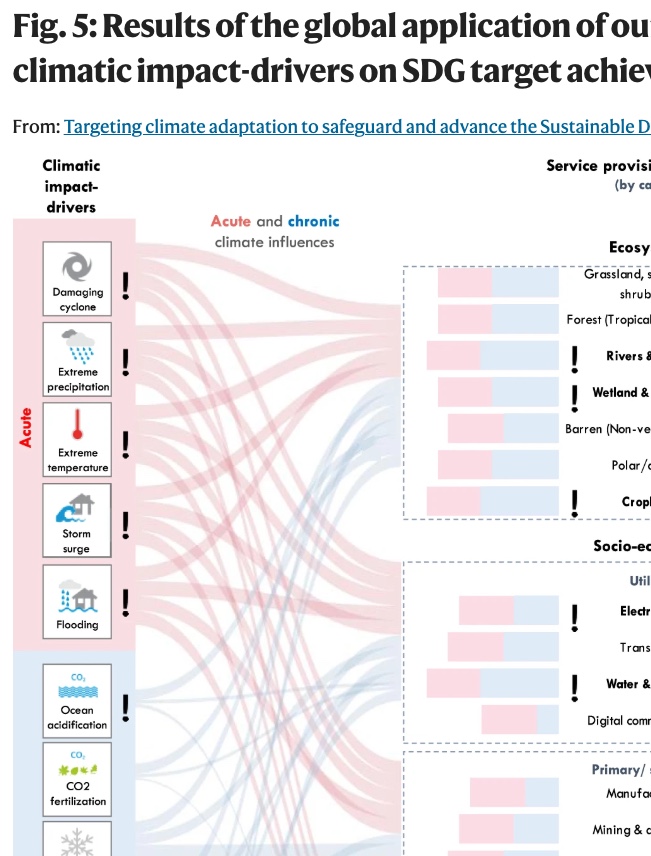
Targeting climate adaptation to safeguard and advance the Sustainable Development Goals
March 2022Here we propose a framework to conceptualise how ecosystems and socio-economic sectors mediate this relationship, which provides a more nuanced understanding of the impacts of climate change on all 169 SDG targets. Global application of the framework reveals that adaptation of wetlands, rivers, cropland, construction, water, electricity, and housing in the most vulnerable countries is required to safeguard achievement of 68% of SDG targets from near-term climate risk by 2030.
Academic Publication -

Guidelines for successful, sustainable Nature-based Solutions
January 2022Back in 1992, at the United Nations Earth Summit, the three Rio Conventions were established (one on climate change, one on biodiversity, and one on desertification), but while their interdependencies were acknowledged at the time, the policy, practice, and research communities that grew around each convention largely followed independent trajectories. Until now.
Report/Brief -

Can sustainability certification deliver climate resilience for smallholder farmers? The case of Ghanaian cocoa
January 2022Sustainability certification has been posited as a key governance mechanism to enhance the climate resilience of smallholder farmers. Whilst many certifications now include climate resilience in their standards, their ability to deliver this for smallholders remains untested. We take the case of the 2015–16 drought-shock to cocoa production in Ghana to examine whether certification can enhance smallholder climate resilience.
Academic Publication -

Nature-based Solutions in Bangladesh: Evidence of Effectiveness for Addressing Climate Change and Other Sustainable Development Goals
November 2021Many lower-income countries are highly vulnerable to the impacts of natural disasters and climate change, due to their geographical location and high levels of poverty. In response, they are developing climate action plans that also support their sustainable development goals, but conventional adaptation approaches such as hard flood defenses can be expensive and unsustainable.
Academic Publication -

Ensuring Nature-based Solutions support both biodiversity and climate change adaptation
October 2021To better understand the biodiversity outcomes of NbS implemented for climate change adaptation. Although nature-based solutions (NbS) should by definition support biodiversity, not all projects framed as NbS have been shown to achieve this in practice.
Report/Brief -

Tackling climate change with nature-based solutions in Bangladesh
October 2021Nature-based solutions are a vital tool for climate change adaptation. Our review found robust evidence that they can provide resilient and effective protection from climate risks while also supporting sustainable development and enhancing biodiversity.
Report/Brief -

Reducing people’s vulnerability to climate change in the rural Global South using Nature-based Solutions
October 2021To implement nature-based solutions such as ecosystem restoration. Our research shows that such actions can help reduce people's vulnerability to climate change impacts across a diversity of social and environmental contexts
Report/Brief -

Nature-based solutions in UK climate adaptation policy
October 2021A report providing evidence that a wide range of NbS are being deployedin the UK, protecting and enhancing the services that nature provides.
Report/Brief -

Can Nature-Based Solutions Deliver a Win-Win for Biodiversity and Climate Change Adaptation?
October 2021We conducted a systematic review of the outcomes of 109 nature-based interventions for climate change adaptation using 33 indicators of ecosystem health across eight broad categories (e.g. diversity, biomass, ecosystem functioning and population dynamics).
Academic Publication -

Investing in Nature for Development
August 2021We need to put the protection and restoration of nature at the heart of the healing and recovery of human society from the ravages of the pandemic
Report/Brief -

Nature-based solutions can help cool the planet — if we act now
May 2021Analysis suggests that to limit global temperature rise, we must slash emissions and invest now to protect, manage and restore ecosystems and land for the future.
Academic Publication -

Conserving the Cerrado and Amazon biomes of Brazil protects the soy economy from damaging warming
May 2021In tropical regions, widespread loss of native forest and savanna vegetation is increasing extreme heat, particularly in agricultural regions. Using the case of rising extreme heat from lost forest and savanna vegetation in Brazilian Amazon and Cerrado regions, we modeled losses to soy production, the region’s principal economic activity.
Academic Publication -

Enhancing smallholder climate resilience in banana and cocoa global food value chains
May 2021The global food system is a complex socio-ecological system performing the critical service (with varying degrees of success) of nourishing humanity’s food and nutrition needs. This system is under threat from, amongst others, a range of climate related shocks, including extreme weather events as well as more gradual stressors.
Academic Publication