
NbSI at London Climate Action Week
NbSI joined London Climate Action Week, advocating for aligned action on nature and climate across law, food systems and climate governance. Prof Nathalie Seddon addressed the National Emergency Briefing for Law - a new climate conversation highlighting the need action to put climate and nature at the heart of decision making across the legal profession. July 3, 2026
Amidst a record-breaking heatwave, thousands gathered across London to discuss action on climate change. The NbSI team participated in key events across law, food systems and climate governance, advocating for action on climate which integrates nature and people.
Nature, law and the courage to act
Prof Nathalie Seddon shared evidence on the urgent importance of addressing the nature crisis at several London Climate Action Week events, including the National Emergency Briefing for Law and a People’s Emergency Briefing screening at The Conduit.
At the National Emergency Briefing for Law, which opened London Climate Action Week 2026, lawyers, judges, scientists, policymakers and sustainability leaders came together to explore what climate and ecosystem breakdown mean for the legal profession. Nathalie’s contribution focused on one of the most damaging myths of modernity: the idea that nature sits outside human life – as a resource to use, a place to visit, or a problem to manage. Science and lived experience tell a different story. Human health, food security, infrastructure resilience, economic stability and legal order all depend on functioning living systems.
Nathalie’s contribution focused on one of the most damaging myths of modernity: the idea that nature sits outside human life – as a resource to use, a place to visit, or a problem to manage.
Yet, the UK is one of the most nature-depleted countries on Earth. Since 1970, monitored wildlife populations have declined by around 19%, one in six species is at risk of extinction, only 14% of rivers in England are in good ecological status, and only a small fraction of land and sea is effectively protected for nature. For the legal profession, these harms are no longer remote or abstract. Nature loss creates material risks for homes, health, food systems, insurance, supply chains, public finances and intergenerational justice. Protecting and restoring nature is therefore fiscal and security policy and sound legal governance.
Later in the week, at The Conduit, Nathalie spoke about the need to re-cultivate a culture of care for the living world. In high-consuming societies such as the UK, behaviour change matters deeply: how we move our money, eat, travel, vote, build, invest and use our professional influence has effects far beyond our shores. Her key message was that social tipping points are possible. When nature-positive choices become visible, affordable and normal, they can spread through communities, institutions and markets. Care may sound gentle, but its implications are profound: it changes what we notice, what we value, what we protect and what we are willing to transform.
Her main message throughout the week, was that though the nature-climate crisis is real, so too is our agency.
Watch a recap of the Briefing here: National Emergency Briefing for Law on the Climate and Nature Crisis
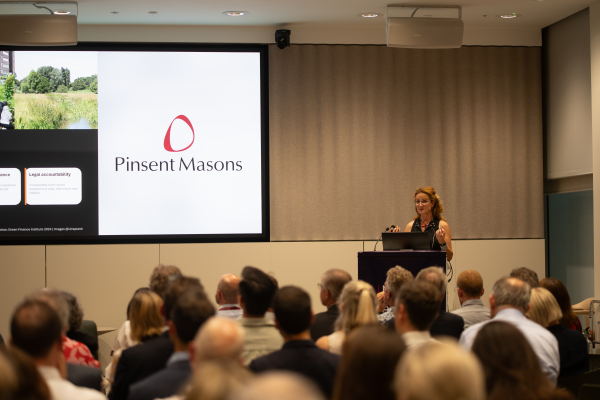
Prof Nathalie Seddon explained why protecting and restoring nature is fiscal and security policy and sound legal governance
Tackling climate and nature through food systems: the potential of pulses
Dr Jing Zhang presented the newly launched UK Pulses Roadmap, a collaborative project led by the Agricultural Resilience Impact & Innovation Hub (AGRIIH) at NbSI and Food Systems Transformation Group at Environmental Change Institute.
Speaking at the LCAW session Nature on our Plates: What Are We Regenerating and How?, Jing highlighted how pulses can contribute to more resilient farming systems, healthier diets and wider nature and climate goals. The session explored why scaling pulses is not simply a production challenge, but a food systems challenge requiring coordinated action across farming, supply chains and consumption. The discussion brought together researchers, policymakers, businesses and civil society to reflect on how regenerative ambitions can translate into practical food system transformation.
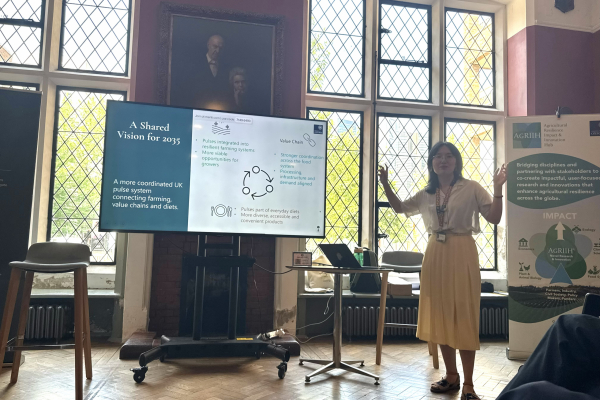
Dr Jing Zhang presented the new UK pulses roadmap at London Climate Action Week
Explore the full roadmap here: A roadmap for UK pulses: Releasing pulses’ potential for nutrition, nature and net-zero
The People’s COP: Reimagining Climate Governance
An exhibition of photos taken by Dr Aline Soterroni at the COP30 People’s March in Belém, Brazil, illustrated conversations around the need for stronger Indigenous and traditional communities leadership in climate governance. The event asked the question: Who should be shaping climate governance?
Discussions highlighted how Indigenous leadership, ancestral knowledge, territorial rights and grassroots organising can build climate solutions which are both more equitable and more effective. While climate solutions are increasingly framed around corporate interests and investment agendas, the event grounded climate action with environmental defenders and community leaders whose knowledge comes from protecting ecosystems and defending against destruction on the ground.
Hosted by non-profit Brazil Matters.
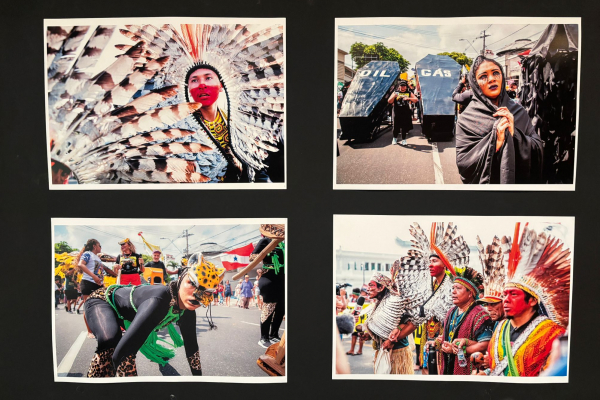
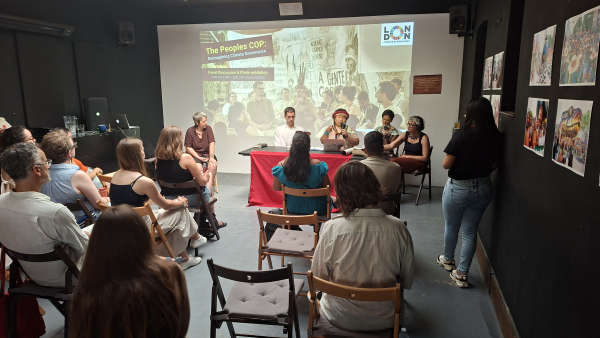
Aline Soterroni’s photos of the COP30 People’s March illustrated an event on Reimagining Climate Governance.