
Groundswell Festival: Sharing Oxford’s Agricultural Research
At Groundswell Regenerative Agriculture Festival, the AGRIIH marquee was a hub for all things agriculture resilience. Researchers from across the University of Oxford showcased agricultural research across disciplines, from soil biodiversity to agricultural policy and beyond. July 8, 2026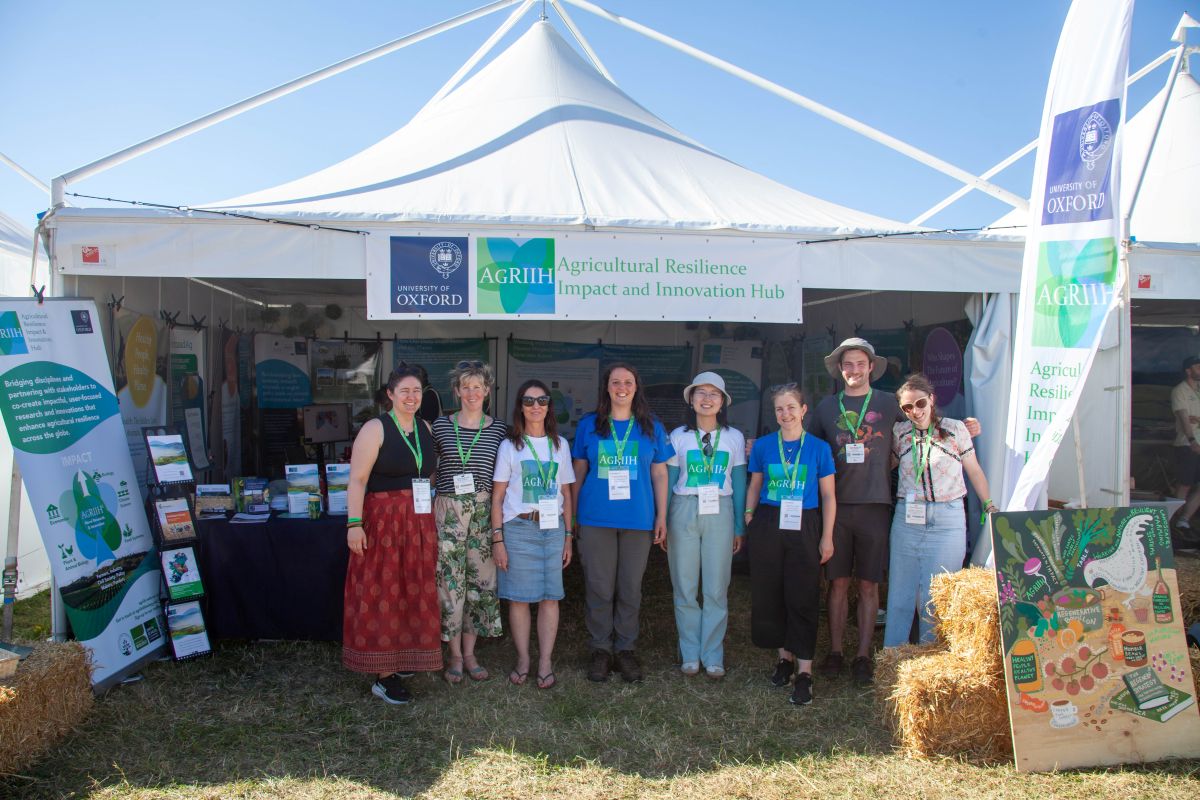
Groundswell – the highlights
Written by Dr Jing Zhang
At Groundswell 2026, the Agricultural Resilience Impact and Innovation Hub (AGRIIH) brought together colleagues from across the University of Oxford in a shared marquee. Rather than representing a single project, the space hosted researchers from Biology, Smith School of Enterprise and the Environment, Environmental Change Institute, School of Geography and the Environment, the Oxford Martin School and beyond, showcasing the breadth of Oxford’s work on agriculture.
Coordinating a shared presence also created opportunities that would have been difficult for individual projects alone. By presenting complementary research side by side, we were able to spark conversations that crossed disciplinary boundaries and demonstrate how different approaches—from soil biodiversity and landscape monitoring to regenerative agriculture, agricultural policy and food systems—contribute to a common challenge: building more resilient agricultural systems. Read more about the research in the extended blog below.
The atmosphere throughout the two days was incredibly positive. We had the opportunity to engage with farmers, advisers, NGOs, policymakers, researchers and industry representatives, leading to many new conversations and connections. In particular, the two AGRIIH workstreams also attracted considerable interest. Copies of the UK Pulses Roadmap were distributed over the two days, while the multicropping workstream connected us with researchers, farmers and organisations already working in this area or keen to become involved. These conversations have already opened up promising opportunities for future collaboration and knowledge exchange.
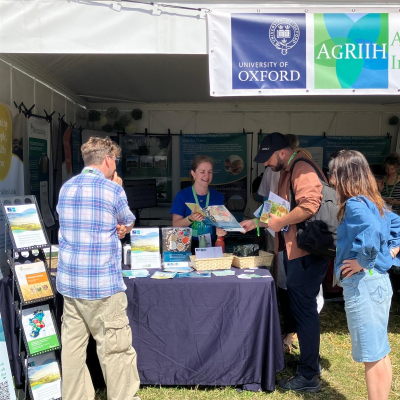
Dr Jen Lucey shares the UK pulses roadmap at the AGRIIH marquee. (Photo credit: Frances Manning).
Themes from conversations were illustrated in the form of a mural, painted live throughout the festival by Dr Cécile Girardin (see extended blog below).
More broadly, Groundswell demonstrated the value of bringing Oxford researchers together under a single banner. Having a shared space encouraged conversations that connected different projects and disciplines, while also making it easier for external stakeholders to engage with Oxford’s expertise as a whole. For AGRIIH, the event reinforced the role of the Hub as a platform for convening researchers, fostering interdisciplinary collaboration, and building lasting partnerships with the farming and wider agricultural community.
Find out more about AGRIIH and explore the project outputs: Agricultural Resilience Impact and Innovation Hub
Healthy People, Healthy Planet: how research at Oxford is stepping up to support farmers who are transitioning
Dr Cécile Girardin shares a whistle stop tour of the diverse ecosystem of research showcased at Groundswell, illustrated by a mural painted throughout the festival
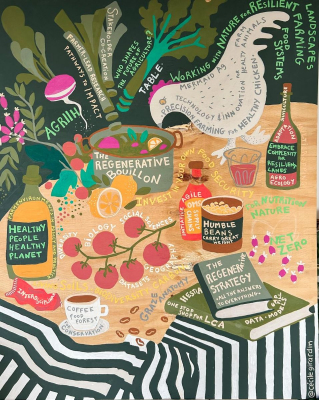
A mural painted by Cécile Girardin illustrated conversations and research themes on agricultural resilience
Lately, I have been diving into the complex world of food systems — where you can find links from the soil microbiome to supermarket shelves, insect behaviour to investment decisions, elephant dung to good consumer choices (you’ll have to watch the Groundswell film for that one!).
Slowly -too slowly- we are moving away from extractive farming practices that deplete our lands, towards farming that restores it — where Regen Ag fields, hedgerows, rivers, protected and restored ecosystems, work together as one living system, and people find their place within nature instead of standing against it.
The University of Oxford’s Agricultural Resilience Impact and Innovation Hub (AGRIIH) aims to facilitate farmer-research cooperation on the transformation of our food systems. AGRIIH convenes researchers across multiple disciplines – from Biology and Geography to the Saïd Business School and Philosophy departments – to build the evidence on regenerative agricultural practices which can provide nutrient rich foods, restore our natural world and contribute to net zero goals. Here is a whistle stop tour of what we were presenting in Groundswell 2026, where 10,000 regenerative agriculture farmers, policymakers, innovators, investors, and researchers came together to focus on the future of regenerative food systems.
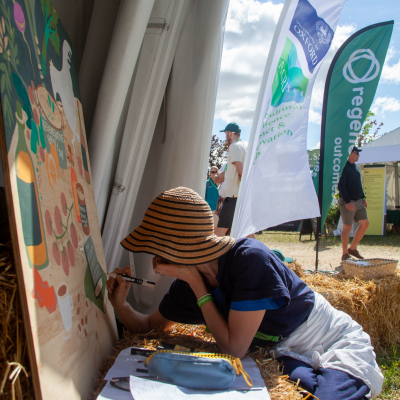
Cécile Girardin painting the mural at the AGRIIH marquee (Photo credit: Jackie Turner)
One Health: tracing bacterial infections from Farm to Fork
Animal health and food safety are inextricably linked. Researchers at the Ineos Oxford Institute for antimicrobial research are tracing how foodborne bacteria travel through the supply chain from farm to fork, to identify risks. Right now, the team is investigating the sharp rise of human cases of Campylobacteriosis in 2024, and why highly antibiotic-resistant strains are persisting even as antibiotic use on farms has fallen.
The research team uses DNA-based tracing to map where these resistant strains show up and how they spread — evidence that could help everyone along the chain, from farmer to processor, close the gaps.
Who Really Shapes the Future of Agriculture?
It’s easy to think farming decisions are made on the farm. In truth, shifts in food demand and production send ripples through financial markets — influencing investor confidence and supply-chain decisions before any visible change happens on the ground. The FoodCost project is putting numbers on something farmers have struggled with for decades: the price at the till rarely reflects the full cost of food. Environmental, health and social costs, the hidden costs, often go unpaid. One striking finding: across the EU, around 82% of farm subsidies are embodied in animal-sourced foods, a reminder of just how much our diets steer the incentives behind entire food systems.
Regenerative Agriculture: what does it mean?
Ask ten people what “regenerative agriculture” means and you may get ten different answers — soil health, biodiversity, carbon markets, new food labels. The Reckoning with Regeneration Agile Initiative research sprint mapped where these visions align, where the evidence is thin, and where the term risks losing meaning through overuse.
That same tension shows up in the meat debate. The same scientific evidence is often used to argue completely opposite conclusions: some say cutting meat consumption is essential for lowering emissions and improving public health; others argue meat is nutritious, culturally significant, and that the real gains lie in farming efficiency. Values and lived experience shape how people read the same data. Understanding these differences is key to finding paths forward that work across diverse farming landscapes.
Graze Anatomy: What’s Happening Beneath Your Feet
“Graze Anatomy,” is a DPhil study by Max Hadoke exploring a practical question: does how you graze livestock change soil life composition? Comparing adaptive multi-paddock (mob) grazing against set stocking across 48 fields on 12 UK farms, researchers found that soil structure — not grazing method alone — was the biggest driver of earthworm biomass. But fields with better soil structure saw a bigger biomass boost under adaptive grazing. Microbial communities tell a similar story: adaptively grazed fields, especially those with more clay in the soil, supported broader, more diverse microbial life. Researchers found that rotational grazing can improve soil health, but the benefits are strongest where soil structure is already being managed.
Farm Invertebrates
Farm invertebrates are an ally and a pest. Oxford’s Bee Lab is studying how bees judge food quality and take cues from flowers —informing better pollination strategies for soft fruit and vegetable growers. Meanwhile, research into aphids and their symbiotic bacteria is revealing natural resistance to parasites, opening the door to more effective, targeted biological pest control, responding to the urgent need to reduce our reliance on chemical sprays.
Embracing complexity in nature
A recurring theme across research at Oxford is that farms which mirror biodiversity and complex natural systems tend to hold up better under stress – I.e. increase ecological resilience. Early results suggest regenerative and rewilded pastures support greater biodiversity and structural complexity than conventional systems — and that this complexity is linked to stronger resilience against climate shocks. Lessons from cacao agroforestry in Ecuador are now informing an ambitious new programme testing temperate multi-crop (silvoarable) systems across Europe.
A cautionary note: standard lifecycle assessments often fail to capture the full value of regenerative practices, because they are not well suited to measuring multi-functional benefits or impacts that unfold over years.
Tools for ecologically sound decisions
Good decisions need good data. The Nature-based Solutions Knowledge Hub offers a one-stop guide to designing and funding nature-based solutions in the UK. HESTIA, a free database, standardises data on farm practices and environmental impacts — letting users compare footprints like global warming potential, water use and land use across different production systems.
On the more experimental end, researchers are developing AI tools that make sense of whole ecosystems or ‘soundscapes’ — separating birdsong from weather and machinery noise — alongside demographic modelling that tracks how species respond to climate extremes, and early trials of drones and autonomous robots for scalable ecological monitoring.
Technology and innovation for animal wellbeing
From the largest livestock to the smallest pollinators, technology is opening new doors in animal welfare. Bovine TB leads to the culling of tens of thousands of UK cattle every year; Oxford scientists have developed ‘bovine immune organoids’ — essentially an ‘immune system in a dish’ — to test vaccines faster, more ethically, and more cheaply. OpticFlock, a camera-based monitoring system, tracks flock movement patterns to flag early signs of lameness in chickens, and can even identify flocks at risk of Campylobacter infection well before standard tests would catch it.
Farm Environments in Policy and Practice
None of this matters if it doesn’t reach the people making decisions on the ground. The Defra-funded Farm Environments in Policy and Practice project uses participatory, farmer-led methods to shape how agri-environment schemes are designed during the post-Brexit transition — ensuring policy is grounded in the practical reality, not just theory.
Weaving it all together – AGRIIH
Whether it’s earthworms, antibiotic resistance, subsidy structures, or drone-based monitoring, the message from Oxford’s agricultural researchers is consistent: farming resilience is not a single fix, it is a web of interconnected systems — soil, animals, economics, policy and people.
The Agricultural Resilience Impact and Innovation Hub (AGRIIH) at the University of Oxford brings together researchers from across disciplines and works with industry and other stakeholders to co-develop innovative, industry-relevant research that can help transform agricultural systems towards a more sustainable and resilient future
For farmers navigating rising costs, shifting policy, and an unpredictable climate, that collaborative, ground-up approach — listening as much as it studies — may be exactly what’s needed.
To find out more or get involved, visit https://www.naturebasedsolutionsinitiative.org/projects/agricultural-resilience-impact-and-innovation-hub/
Read more about Oxford research on Nature, Food and Farming: https://www.agile-initiative.ox.ac.uk/wp-content/uploads/2026/01/Oxford-Food-Farming-Catalogue-Jan-2026.pdf