
Chocolate bushbabies: how cocoa farms could provide a home for wildlife
Chocolate and bushbabies may seem an unlikely pairing. But new research from Ghana suggests that cocoa farms could have an important role to play in supporting these small, nocturnal primates. The findings support evidence for agroforestry systems as nature-based solutions that can benefit biodiversity and people. September 8, 2026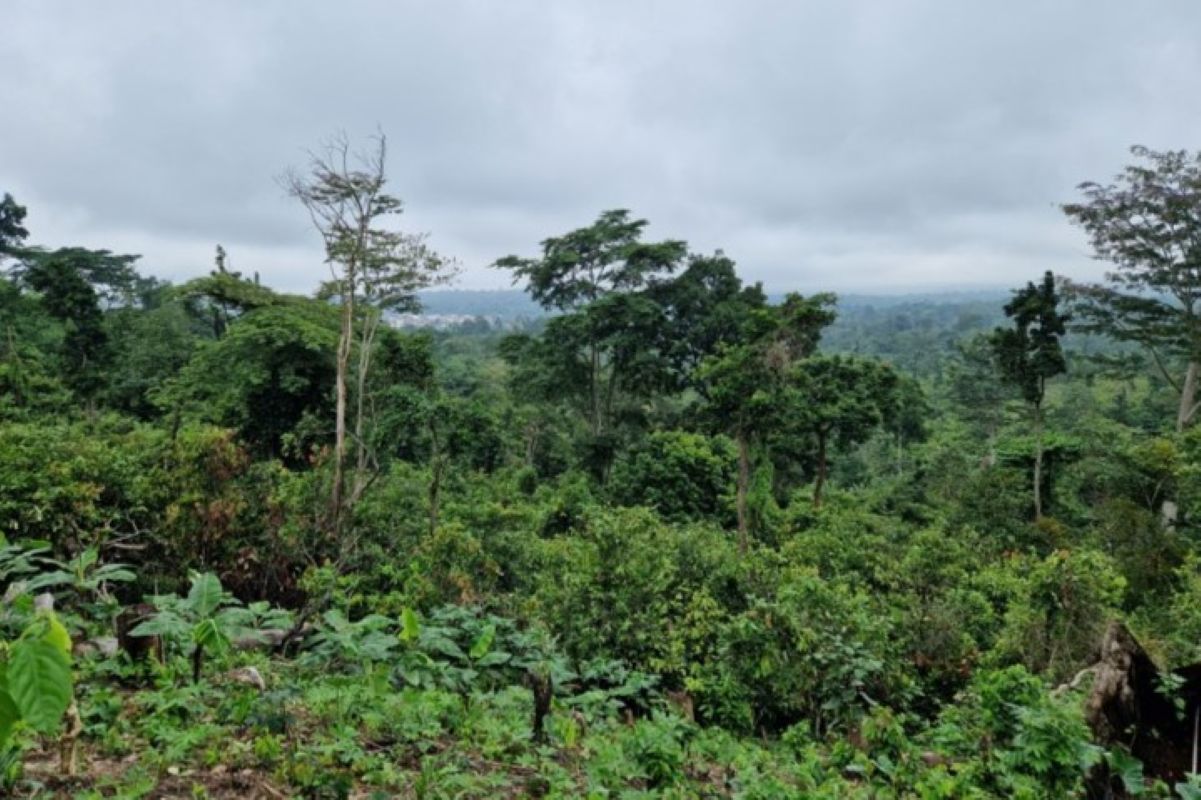
Written by Dr Daniel Hending
Chocolate and galagos, otherwise known as bushbabies, may seem an unlikely pairing. But new research published in Ecology and Evolution suggests that cocoa farms could have an important role to play in supporting these small, nocturnal primates.
Agroforestry as a nature-based solution
Tropical forests are home to an extraordinary variety of wildlife, but they are increasingly being cleared or broken into smaller patches as land is converted for farming. This is a particular problem for primates, most of which depend on forests for their survival.
However, not all farmland is the same. In agroforestry systems, crops are grown alongside trees and other vegetation. This can make farms more hospitable to wildlife than intensively managed monoculture farmland, while also providing benefits to people. These benefits, known as ecosystem services, can include pollination, pest control, soil nutrient cycling, and carbon storage.
Cocoa is often grown in agroforestry systems, with cocoa trees beneath taller shade trees. In West Africa, where around 70% of the world’s cocoa is produced, these farms cover large areas of former forest habitat. We therefore wanted to know whether cocoa agroforests could also provide habitat for galagos. These small African primates live in trees, are active at night and eat foods including insects, fruit and tree gum.
Listening for galagos
We studied 38 cocoa farms in Ghana’s Ashanti Region, and rather than trying to spot galagos in the dark, we listened for them using passive acoustic surveys. Small recording devices were placed on each farm to record sounds overnight. We then used a computer model trained to recognise different galago calls, where potential calls identified by the model were manually checked to confirm whether galagos were really present. We also mapped nearby forest to investigate whether galago detections were related to the farms’ proximity to remaining forest patches and protected forest reserves.
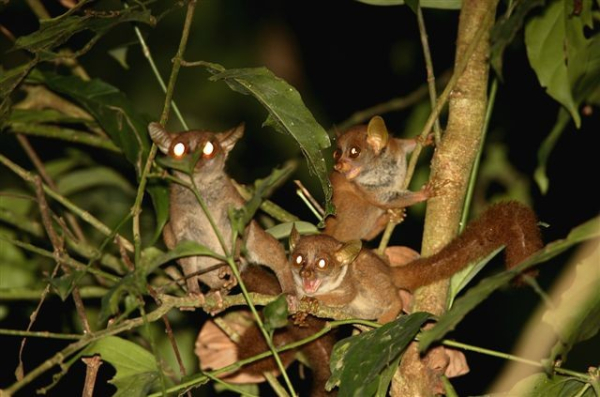
This is the first scientific record of galagos (bushbabies) using cocoa agroforests. Photo by Thomas Butynski (co-author)
What did the study find?
Galagos were confirmed on four of the 38 cocoa farms surveyed, representing the first scientific records of these primates using cocoa agroforests. Interestingly, all four farms were within 500 metres of a remaining patch of forest, with three less than 150 metres away. However, the farms were much further from large protected forest reserves, suggesting that small patches of natural forest within agricultural landscapes could be particularly important for the survival of these primates.
There are still unanswered questions. We could not determine exactly which species we detected, or whether the galagos were living permanently on the cocoa farms or simply travelling through them. The automated detection system also produced many false alarms, mainly because some insect sounds resembled galago calls.
Farming with nature
The findings of the study highlight the potential value of nature-friendly farming alongside protecting natural forests. Cocoa agroforests could provide additional habitat or act as corridors and “stepping stones”, helping wildlife move between isolated patches of forest. Galagos could potentially benefit farmers too; by eating insects they may help control crop pests, while their role in spreading seeds could support vegetation and soil health. However, more research is needed to establish whether these benefits do indeed occur on cocoa farms.
Cocoa agroforestry cannot replace intact tropical forest, but this study shows why conservation does not have to stop at the forest boundary. Maintaining shade trees and small forest patches within productive landscapes could help create farms that produce food and income while also providing space for wildlife, a promising example of how working with nature can benefit both people and biodiversity.
Read the paper here: Hending et al. (2026). Chocolate Bushbabies: Cocoa Agroforests as Habitat for Galagos (Galagidae) in the Ashanti Region, Ghana
Find out more about the Flourishing Landscapes Programme.
The Flourishing Landscapes Programme (FLP), led by NbSI’s Dr Will Thompson, is one of thirteen recipients of the first round of research grants awarded by the Global Centre on Biodiversity for Climate (GCBC) – a UK Official Development Assistance (ODA) research and development programme that funds research to unlock the potential of nature to provide climate solutions and improve livelihoods. It is funded by the UK’s Department for Environment, Food and Rural Affairs working in partnership with DAI Global as the Fund Manager Lead and the Royal Botanic Gardens, Kew as the Strategic Science Lead. Learn more about GCBC and this grant.