
When Nature Fails, So Do We: Inside the UK’s National Emergency Briefing
On Thursday 27 November, over a thousand MPs, peers, senior civil servants, mayors, faith leaders, journalists, artists, activists, business and community leaders filled Central Hall Westminster for the UK’s first National Emergency Briefing on the Climate and Nature Crisis - delivered by ten of the UK's leading experts including NbSI Director Nathalie Seddon. December 3, 2025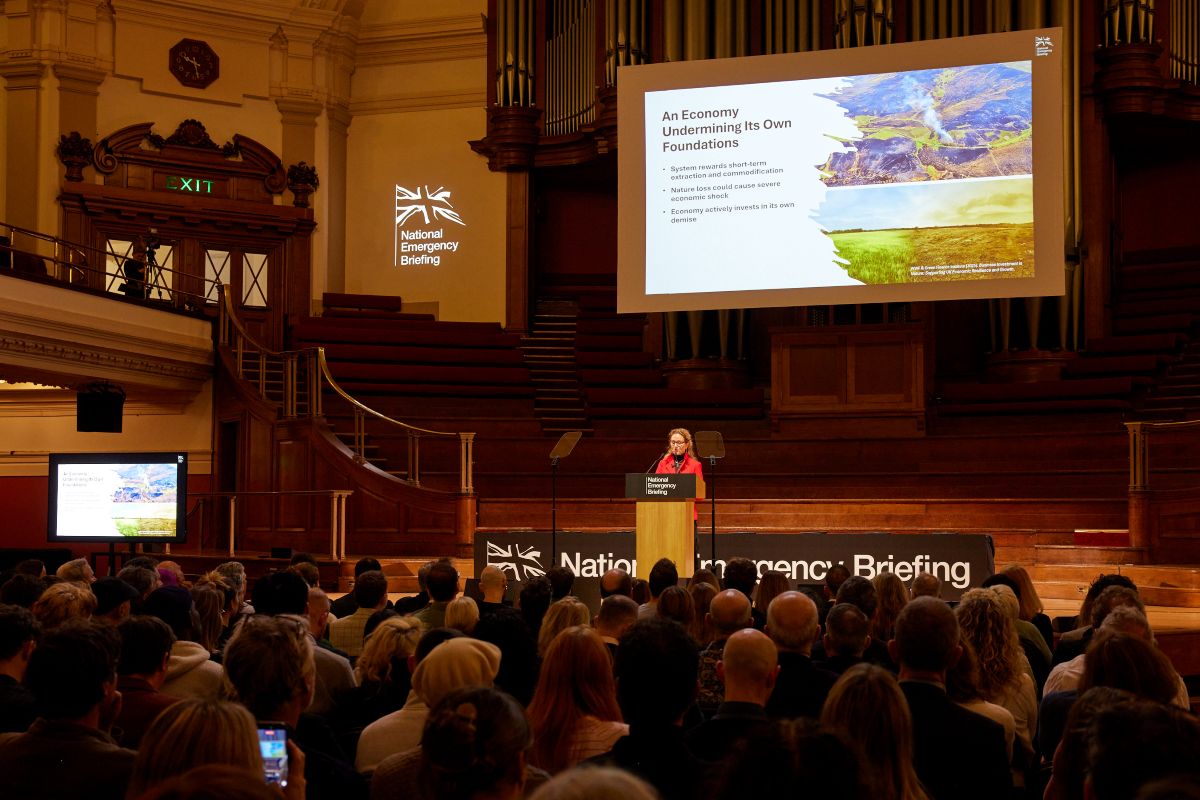
On Thursday, 27 November, Central Hall Westminster was filled with hundreds of MPs, peers, senior civil servants, mayors, faith leaders, journalists, artists, activists, business and community leaders for the UK’s first National Emergency Briefing on the Climate and Nature Crisis.
Chaired by Professor Mike Berners-Lee and opened by broadcaster Chris Packham, the event set out to do something simple and radical: give decision-makers a clear, evidence-based assessment of how climate breakdown and nature loss are already undermining the safety and prosperity of everyone in the UK, and what can still be done to change course.
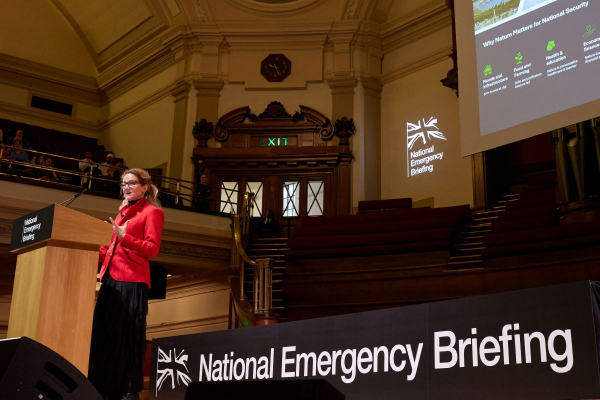
Prof Nathalie Seddon, Director of the Nature-based Solutions Initiative at the University of Oxford, was the first expert witness invited to give evidence.
Her main message was simple:
“Nature is not a ‘nice to have’; it is critical national infrastructure.”
She went on to warn that: “We are facing a national emergency not only because the climate is changing, but because the living systems that regulate that climate, protect our homes, and feed our people are breaking down, here, in one of the most nature-depleted countries on Earth.”
This briefing was designed to change that. If you weren’t in the hall, you can still be part of this.
How you can get involved:
- Watch and share the full National Emergency Briefing recording (3 hours)
- Watch and share the 26-minute summary by Dave Borlace (“Just Have a Think”) which gained 200,000 views in the first 24 hours
- Sign and share the open letter calling for a televised National Emergency Briefing for the public and a sustained public-information campaign (30,000 signatures and counting)
A first-of-its-kind briefing
The National Emergency Briefing was convened by a small volunteer team of campaigners and communicators, supported by organisations across the environment, faith and academia. Inside Central Hall Westminster, over a thousand people listened as ten experts from different disciplines painted a joined-up picture of the risks facing the UK. Across these contributions, one message was repeated in different ways: we are not prepared for the risks we have already locked in, but we still have time to act if we treat this as an emergency and invest in nature-positive solutions at speed and at scale.
The state of UK nature and why it is a security issue
Prof Seddon’s evidence set out why nature loss is central to the UK’s security, stability and prosperity.
1. A nature-depleted nation
The UK now ranks in the bottom 10% of countries globally for biodiversity intactness. We have lost almost half of our original biodiversity; monitored wildlife populations have declined by nearly a fifth since 1970; and around one in six species is threatened with extinction. This is not just a loss of beauty and natural heritage (important though that is). It is the slow dismantling of the systems that grow our food, regulate floods, filter water, buffer heatwaves, and support our mental and physical health.
2. Rivers, wetlands and peatlands in crisis
Only about 14% of rivers in England are in good ecological health, with pollution from sewage, agriculture and urban runoff contributing to a dangerous chemical mixture in our waterways. Our peatlands, which should act as vast, natural carbon stores and sponges that hold water in the landscape, are mostly degraded. Many have flipped from being carbon sinks to sources of greenhouse gas emissions, while losing their capacity to retain water and protect communities from floods and droughts.
3. Flood and food security
Around 6.3 million properties in England are already at risk of flooding. On our current trajectory, that could rise to roughly 8 million (about one in four properties) by the middle of the century. At the same time, climate impacts and nature loss are undermining food production. Extreme weather is already reducing yields, and more than half of England’s best agricultural land is itself at risk of flooding. As Paul Behrens reminded us, the food system is both vulnerable to climate shocks and a major driver of them. Shifting towards healthier, more plant-rich diets and nature-positive farming is essential for both food and climate security.
4. Health, wellbeing and productivity
As Prof Hugh Montgomery set out, climate and nature breakdown is already a public-health emergency: increased heat-related deaths, more cardiovascular and respiratory disease driven by air pollution and wildfires, and mental-health pressures, especially after climate-related disasters.
On the flip side, access to thriving green and blue spaces is associated with lower anxiety and depression, better cardiovascular health, and improved learning outcomes for children. In other words, nature-based solutions in towns and cities are not a luxury; they are a core part of an equitable health strategy.
5. Economic and financial risk
Recent analysis by the Green Finance Institute and WWF suggests that, if we continue to degrade nature, nature-related risks alone could reduce UK GDP by nearly 5% over the next decade, and by up to 12% in more severe scenarios, larger than the shock of the 2008 financial crisis or Covid-19. Yet large flows of public and private finance still go into activities that damage ecosystems, effectively subsidising systemic risk. By contrast, evidence from the UK and beyond shows that investment in nature, from woodland creation to wetland restoration, can deliver very high benefit-cost ratios once benefits like flood protection and health are included.
Nathalie’s conclusion was clear:
“This is not about choosing between the economy and the environment. The economy is embedded within the environment. Without functioning ecosystems, there is no long-term food, water or energy security, and no stable foundation for public finances.”
Voices from climate, weather, health, security and law
The other experts built on and reinforced this picture.
- Kevin Anderson warned that we face a choice between “deep, rapid and fair decarbonisation of modern society” and a pathway where continued delay leads to chaotic and potentially violent disruption.
- Tim Lenton explained how we are edging towards dangerous climate tipping points, including a potential weakening of the Atlantic Meridional Overturning Circulation. A collapse would disrupt weather patterns, threaten UK agriculture and leave us far more exposed to global food shocks.
- Paul Behrens outlined how the food system is both vulnerable to climate shocks and a major driver of them, highlighting the need for a ‘Great Food Transformation’, including a shift towards healthier, more plant-rich diets, reduced food waste and nature-positive farming.
- Hayley Fowler showed how UK communities are already living with more intense downpours, flash floods and record-breaking heat, and how current adaptation plans are not keeping pace with the risks.
- Hugh Montgomery underlined that climate change is a public-health emergency, with the NHS already straining under heat, air pollution and flood-related illness. Climate inaction is, in his words, a “health policy failure”.
- Lt Gen Richard Nugee described climate and nature breakdown as “threat multipliers” that amplify conflict, drive displacement, and undermine the resilience of critical infrastructure, arguing that they already pose a bigger strategic risk to the UK than many traditional security threats.
- Angela Francis reframed climate and nature action as a once-in-a-generation opportunity to build a fairer, more resilient economy, not a brake on growth.
- Tessa Khan made the legal and democratic case for aligning UK policy with climate and nature safety, noting that continuing to approve new fossil fuel projects is incompatible with the science.
Beyond Westminster, faith leaders and civil society echoed these messages. A reflection in The Observer by Rabbi Jonathan Wittenberg, who also participated in the event, spoke of the moral responsibility to act, and the need to nurture faith in our collective power to confront the crisis rather than turning away in despair.
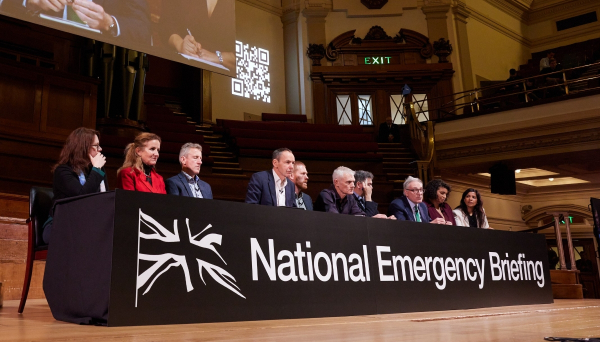
Ten of the UK’s leading experts across climate, nature, weather, health, security and law delivered the briefing
Five priorities for a nature-secure UK
Drawing on the science and on NbSI’s work, Nathalie set out five priorities:
1. Treat nature as critical infrastructure
Nature must sit alongside transport, energy and digital systems in national risk assessments, infrastructure strategies and spending reviews. That means integrating the restoration of rivers, peatlands, wetlands, woodlands and urban green spaces into core infrastructure plans rather than treating them as optional extras.
2. Stop funding harm, reward restoration
Public money and private finance still flow into activities that erode soils, drain wetlands, pollute rivers and destroy habitats. Redirecting harmful subsidies and investments towards high-integrity, rights-based nature-based solutions – from agroecological farming and urban NbS to peatland and saltmarsh restoration – would reduce systemic risk while creating decent jobs in rural and urban areas.
3. Redirect finance and measure what matters
Regulators and central banks need to treat climate and nature risk as a core financial-stability issue, not a peripheral ESG concern. That means:
- Requiring robust disclosure of climate- and nature-related risks.
- Support for the development of high-integrity NbS markets that genuinely benefit biodiversity and communities.
- Tracking tangible outcomes beyond carbon such as homes protected from flooding, heat-related deaths avoided, and savings to the NHS.
4. Cultivate a culture of care
National security begins in communities. Embedding nature into everyday life – from outdoor learning in schools to accessible local green and blue spaces, community-led restoration projects and genuine partnership with local communities – helps to build social cohesion and resilience as well as ecological health. Nathalie urged that we have to build agency, and make it easier and more joyful for people to care and act.
This is about rights and responsibilities: supporting people to care for the places they depend on, and recognising that this care is a form of security work.
5. Build an economy that works with nature, not against it
Reforming economic rules and incentives so that they reward reciprocity, stewardship and regeneration, rather than extraction and short-term profit. That includes aligning fiscal policy, trade, planning and financial regulation with the goal of a nature-positive, net-zero UK, in line with the Paris Agreement and the Global Biodiversity Framework.
High-integrity NbS can play a central role in this transition – but only if they enhance biodiversity, uphold human rights and are developed with, not for, communities.
From briefing to movement – what you can do
The organisers are clear that 27 November was a beginning, not an end. The filmed briefing will underpin a nationwide campaign, with community screenings and conversations around the country. MPs and councillors will be invited to attend, listen and respond.
In the hall, attendees were invited to sign an open letter to Prime Minister Keir Starmer and to all major UK public service broadcasters, calling for:
1) A televised National Emergency Briefing for the public on the climate and nature crisis.
2) A sustained, non-partisan public-engagement campaign so that everyone understands the risks and the solutions.
That letter now has tens of thousands of signatures and is growing fast. You can sign and share the letter here: https://www.nebriefing.org/open-letter-keir
For NbSI, the briefing underlined the urgency of our work with partners across science, policy and practice to:
- Strengthen the evidence base for high-integrity nature-based solutions.
- Support communities, cities and regions to design NbS that deliver for biodiversity, climate and justice.
- Ensure that national policy treats nature not as a side-issue, but as critical infrastructure at the heart of security and prosperity.
We will continue to collaborate with the National Emergency Briefing team and others to ensure that the science on climate and nature is communicated clearly, honestly, and with the sense of urgency and possibility that this moment demands.
“The good news is that we know what works, and the solutions pay back quickly. Failing to act would be a betrayal of our children and future generations.” – Prof Nathalie Seddon, National Emergency Briefing, 27 November 2025
You can follow the National Emergency Briefing and sign the open letter on their website.