
At the interface of science and policy: IPBES12 Plenary on Business and Biodiversity
Following a week of negotiations in Manchester, more than 150 governments have approved the Summary for Policymakers of the new Assessment: Impact and Dependence of Business on Biodiversity and Nature’s Contributions to People. The BizBiodiversity Assessment makes it unequivocally clear that all businesses depend on and impact biodiversity and can be agents of positive change. February 18, 2026
“It’s bonkers,” whispered a colleague as we looked out across the room.
There is no other way to describe the first time you walk into a plenary of this scale. Imagine 150+ country delegations, more than 1000 delegates – mostly scientists and policymakers- sitting in a massive, repurposed train station in Manchester, focused intensely on a single task: negotiating and approving the final wording of the Summary for Policymakers (SPM) of the 2026 IPBES assessment: The impact and dependence of business on biodiversity and nature’s contribution to people, or BizBiodiversity for short.
The BizBiodiversity assessment provides the wealth of evidence we need to guide the business community to achieve Target 15 of the Kunming-Montreal Global Biodiversity Framework: “Businesses Assess, Disclose and Reduce Biodiversity-Related Risks and Negative Impacts”. The Summary for Policymakers has now been agreed by more than 150 countries.
The assessment sets out methods for businesses and financial institutions to understand, identify, assess, disclose, and manage nature-related dependencies, impacts, risks, and opportunities, #DIROs. It provides recommendations for governments, financial actors, businesses and financial institutions, and other actors including consumers, NGOs, academia, and Indigenous Peoples and Local Communities (IPLC). Its Summary for Policymakers is designed to be accessible to all.
This is a wake-up call for the business community: all businesses depend on and impact nature. The era of treating biodiversity loss as an “externality” is over; to ignore nature is to ignore business risks – physical, transition and systemic (BizBiodiversity SPM, Fig. SPM.3).
This message echoes growing recognition at national and global scales of the systemic risks posed by nature loss. The UK government’s National Security Assessment identified ecological collapse as a ‘critical national security risk’, while the World Economic Forum’s Global Risks Report 2026 ranks biodiversity loss as the second most severe global risk over the next decade.
But the Business and Biodiversity Assessment goes beyond diagnosing the risk – to identifying opportunities.
“This Report draws on thousands of sources, bringing together years of research and practice into a single integrated framework that shows both the risks of nature loss to business, and the opportunities for business to help reverse this” Matt Jones, co-Chair.
During the assessment’s launch on Monday 9th February, co-Chair Matt Jones reinforced that the main takeaway is that businesses can be positive agents of change, and they can act now. The expert panel summarised the assessment in 10 succinct points (Box 1) (Source: LinkedIn, Matt Jones, BizBiodiversity co-Chair).
Box 1: Top 10 insights from the BizBiodiversity Expert panel.
__________________________________________________________________________________
The IPBES experts listed their top 10 insights from the report:
- Nature is business-critical: what is profitable for business now harms nature, and erodes long-term value. All businesses impact and depend on nature. The growth of the global economy has been at the cost of immense biodiversity loss, which now poses a critical and pervasive systemic risk to the economy, financial stability and human wellbeing.
- From risk to opportunity: businesses can reduce nature-related risks while unlocking new opportunities.
- The gap is stark: Fewer than 1% of publicly traded companies report on how important nature is to their business.
- Reporting is just the start: Disclosure matters, but real progress also depends on action and outcomes.
- Action can be taken now: Our assessment synthesises 25 practical actions, from portfolio management and corporate strategy to site-level operations.
- This isn’t a data problem: the data and methods already exist to manage impacts on nature and strengthen business resilience.
- One size doesn’t fit all: There’s no single method suitable for all business decisions. Our assessment sets out principles on what’s fit for purpose.
- Better decisions come from better knowledge: Combining business insights, science, and Indigenous and local knowledge leads to improved outcomes.
- Action has ripple effects: business leadership can shift behaviour across peers, suppliers, clients, customers, and consumers.
- This is a team effort: businesses can’t do it alone – our assessment outlines 100+ actions for governments, finance, civil society, and others to ensure benefits for both businesses and nature.
Sources: IPBES, 2026; M. Jones, 2026 (Accessed 10/02/26).
__________________________________________________________________________________
Line by line: an insight into how multilateral science-policy negotiation works
The process of multilateral negotiations is slow, methodical, and exhausting. The process is called line-by-line consideration. The Chair reads out each line and invites comments from the floor – “I give the floor to the Democratic Republic of Congo”. A country delegate suggests a change; the Experts (the 3 Assessment co-Chairs and lead authors) respond from the stage, accepting or rejecting the edit based on the scientific evidence, and the content of the assessment chapter being summarised. Text under discussion remains trapped in [brackets] until the chair is confident that they have unanimous support on the paragraph. Only then does the Chair move on.
Despite hitting a number of gridlocks and Parties’ red lines, the atmosphere remained remarkably calm and focused. The negotiations were conducted in a collaborative and positive atmosphere. The Chair frequently called upon our “spirit of collaboration” to maintain momentum. Ultimately, the responsibility rested with the authors of the Business and Biodiversity assessment to ensure the Summary for Policymakers retained the scientific rigour and key messages of the full assessment.
Bringing scientists and policymakers together in this way can resolve apparent divergences by referring to the evidence. Though this underscores the importance of the evidence base itself being both comprehensive and diverse.
The process, while painstaking, builds a careful balance of clarity and integrity – the end result being a Summary for Policymakers which is both policy-relevant and rigorously grounded in the evidence.
In her opening statement, Rt Hon Emma Reynolds emphasised the importance of this role:
“IPBES gives policymakers the tools we need to act wisely and effectively. In an age of misinformation and short-term thinking, it is vital to protect and champion organisations that tell us the truth about our world.”
It is a game of syntax, but this syntax has fundamental implications for the future of our planet: these words form the basis for international goals, national policies, regulations, and how the private sector operate to halt and reverse biodiversity loss.
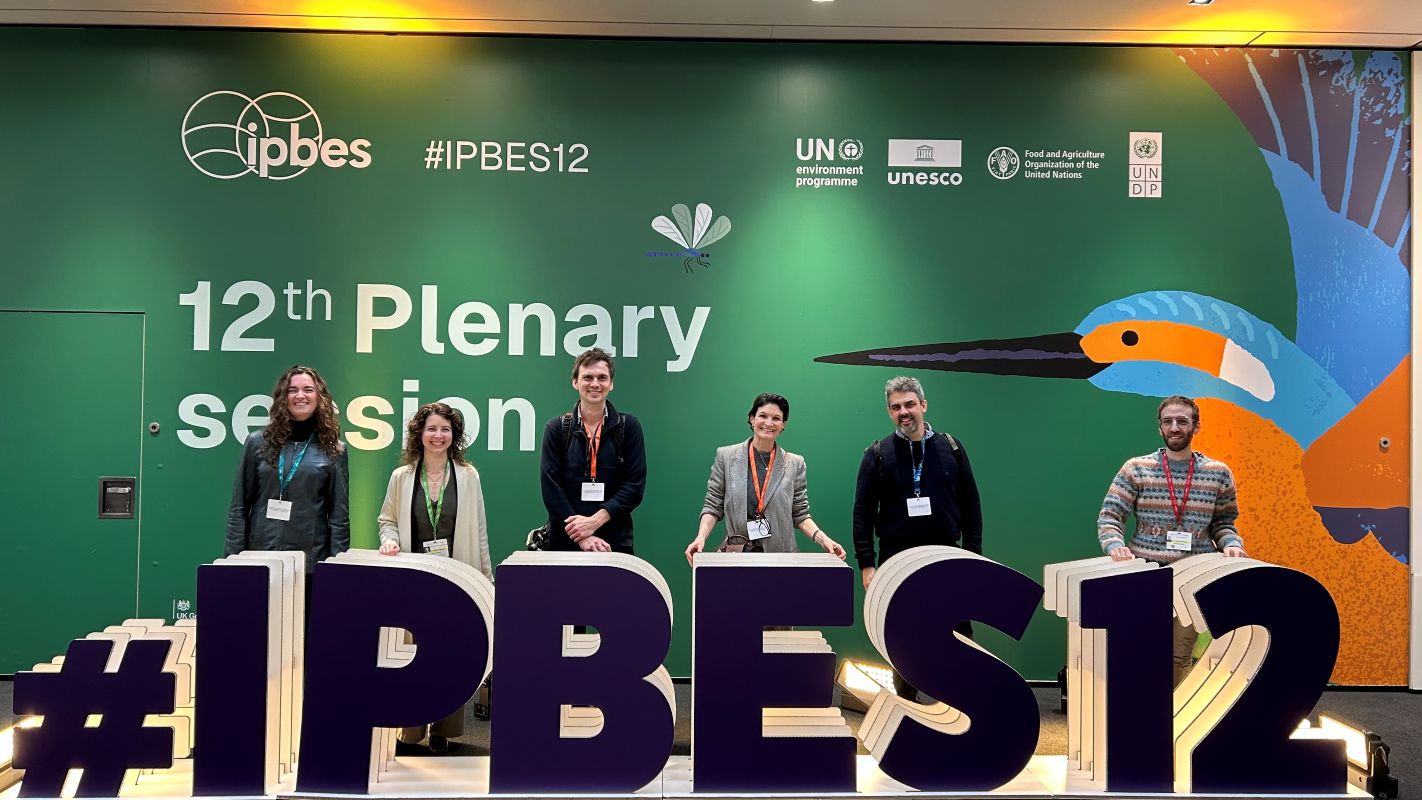
Team members from the Nature-based Solutions Initiative and Nature-based Insights attended the IPBES-12 Plenary to observe negotiations at the science-policy interface
Our highlights from the Business and Biodiversity Assessment
Below we share some of our team’s standout messages from the BizBiodiversity Assessment:
1. Businesses depend on biodiversity, and can act now with existing methods and knowledge
KM1. All businesses depend on and impact biodiversity and can be agents of positive change
The assessment unequivocally demonstrates that all businesses depend on biodiversity, because biodiversity and nature’s contributions to people underpin the economy.
“Better engagement with nature is not optional for business – it is a necessity” – Prof. Ximena Rueda, Co-chair.
The assessment outlines 25 actions that businesses can take now, from corporate strategy to value chains, and emphasises their responsibility to do so.
2. Interweaving diverse knowledge systems for business impacts and dependencies
KM8. Businesses could better measure and manage their impacts and dependencies by appropriately engaging with science and Indigenous and local knowledge, methods and practices {A5, A7, B5, B6, B10, C3, C4, C7,C8}
The report highlights that knowledge and data on business impacts and dependencies within the scientific community, among Indigenous Peoples and local communities (IPLCs) are often siloed and not considered in business decision-making, as that IPLCs are often underrepresented in research and decision-making processes.
It was promising to see the importance of Indigenous and local knowledge recognised in the plenary room, as well as the commitment to embedding equitable principles for collaboration through consent mechanisms including free, prior and informed consent.
However, engagement with Indigenous and local knowledge must be hand in hand with stronger action to prevent and repair the extreme harm that business activities can cause to Indigenous Peoples and local communities, both existing and historically. Continued progress is also needed to further recognise diverse knowledges and perspectives within the IPBES Assessment process itself.
3. Business impacts on human wellbeing and rights
A7. Business impacts on biodiversity and nature’s contributions to people have profound impacts on human health and wellbeing, particularly of Indigenous Peoples and local communities (well established)
The assessment highlights growing recognition that social and human rights considerations should be integrated when businesses assess their impacts on nature. The assessment further identifies groups which are particularly vulnerable to these impacts: ‘women and girls, youth, rural communities and Indigenous Peoples and local communities are especially susceptible to negative impacts from businesses (well established).’
60% of Indigenous lands globally are threatened by industrial development and nearly one-quarter of Indigenous territories are under high pressure from resource exploitation. This is often from extractive industries such as mining and logging, and rising demand for minerals for the energy transition has escalated these impacts.
4. Nature-based solutions: from risks to opportunities
A8. Business impacts and dependencies create both risks and opportunities for businesses (well established)
The assessment identifies nature-based solutions among restoration and ecosystem-based approaches as ‘biodiversity-related’ opportunities for businesses:
“Biodiversity-related opportunities can be created by avoiding harm to biodiversity, mitigating negative impacts, delivering positive ones and managing dependencies sustainably, including through restoration, nature-based solutions and/or ecosystem-based approaches (well established) {1.4.2, 2.2.4, 3.5.3}”
However, addressing the systemic risks of biodiversity loss requires coordinated actions that are beyond what individual businesses currently have incentives or resources to accomplish alone. This is a repeated theme in the assessment: we must build an enabling environment for transformative change.
5. Creating an enabling environment is essential to halt and reverse biodiversity loss
A3. Current conditions perpetuate business-as-usual and do not support the transformative change required to halt and reverse biodiversity loss (well established).
As Key Message 10 further explains: “Under current conditions, what is profitable for businesses often results in loss of biodiversity and what is good for biodiversity and society is often not profitable.”
This imbalance is evident in global finance flows: in 2023 ~$220 billion in global finance flows were directed towards nature-positive activities, while finance flows with directly negative impacts on nature were estimated at $7.3 trillion in 2023. Of this total, private finance accounts for approximately $4.9 trillion, while public spending on environmentally harmful subsidies to economic sectors responsible for biodiversity loss and nature degradation is the remaining ~$2.4 trillion.
“This highlights both the opportunity as well as the need to align financial flows to support biodiversity outcomes” (KM2)
While businesses can act now with existing tools, the assessment is clear that businesses cannot deliver the scale of change needed to halt and reverse biodiversity loss by themselves. Collaboration, collective and individual actions are essential to create an enabling environment. As it currently stands, less than 1% of publicly traded companies report biodiversity.
This is where the Business and Biodiversity Assessment comes in as a lever for change. The assessment identifies firstly, actions businesses can take now to address their impacts and dependencies, and secondly, actions that can be taken by actors across society to create an enabling environment:
“One of the innovations of this Report is that it provides a template for accelerating collaboration and collective actions at all levels among and by governments, financial actors, other actors including civil society, Indigenous Peoples and local communities, consumers, NGOs, international organisations, and academia in addition to the action needed by businesses and financial institutions themselves.” – Prof Stephen Polasky, Co-chair
The Business and Biodiversity Assessment provides the target and the tools.
Now it is in the hands of implementers – to share the findings, embed them into policy and practice, and learn collectively as action unfolds.
Read the Assessment here: Summary for Policymakers of the Methodological Assessment Report on the Impact and Dependence of Business on Biodiversity and Nature’s Contributions to People