
Pathways to strengthen biodiversity protection in oil palm landscapes
A new study published today in Ecological Solutions and Evidence examines the challenges and solutions for protecting biodiversity within oil palm landscapes. Palm oil is a major global commodity, yet its production can come at significant environmental and social costs. Drawing on practitioner interviews, the study proposes recommendations to strengthen biodiversity protection and social safeguards in oil palm landscapes. February 4, 2026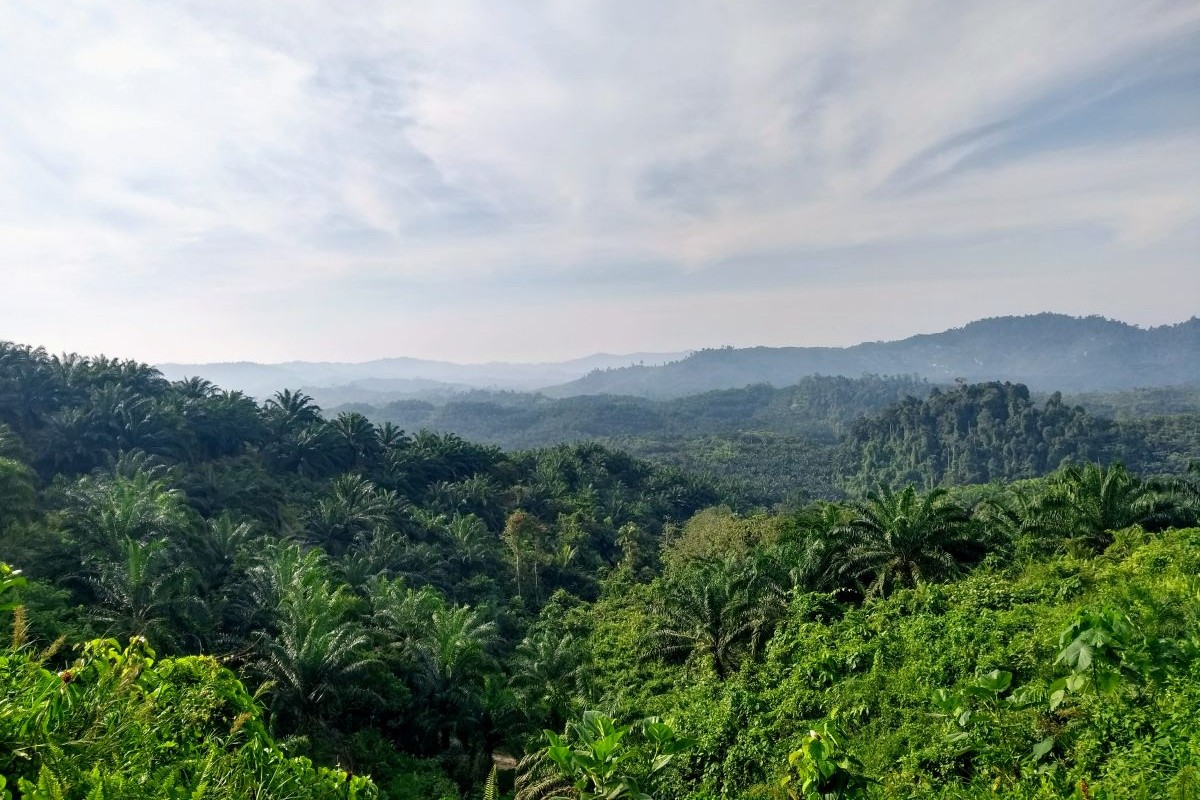
New research out today in Ecological Solutions and Evidence from researchers at the University of Oxford and the University of York, including NbSI’s Dr Jen Lucey, examines the challenges and solutions for protecting biodiversity within oil palm landscapes.
Palm oil is a major global commodity – found in nearly half of packaged supermarket products – yet its production can come at significant environmental and social costs, highlighting the need for nature-based solution approaches that prioritise biodiversity and human wellbeing within palm oil production.
One measure to address this is the Roundtable on Sustainable Palm Oil (RSPO), a certification standard which requires member companies to conserve High Conservation Value (HCV) and High Carbon Stock (HCS) forests within their plantations. However, implementing these commitments effectively remains challenging.
To better understand these barriers, the research team conducted detailed surveys and interviews with 18 sustainability managers from 12 palm oil companies in Malaysia and Indonesia.
The study identified major technical, social, and economic barriers to effective biodiversity management and monitoring within oil palm landscapes.
Some of most common challenges identified by plantation managers were:
- Limited staff expertise in biodiversity monitoring
- Insufficient community participation and unclear land tenure
- Weak use of monitoring data to inform management decisions
- Difficulty convincing senior management of biodiversity’s value
Dr Jen Lucey, co-author and NbSI Deputy Director, explained why tapping into practitioner experience is so important:
“To achieve real conservation impact, we need to bridge the gap between research and practice. By combining scientific evidence with the experience of practitioners, we can better understand what works, what doesn’t—and how we can improve.”
The authors propose a series of recommendations grouped into four key themes: respecting human rights; standardising biodiversity metrics; building capacity and improving sustainability processes. Together these recommendations form a pathway to strengthening biodiversity protection and social safeguards in oil palm landscapes.
Dr Helen Newing, from Oxford’s Interdisciplinary Centre for Conservation Science (ICCS), emphasised the importance of human rights and community engagement:
“Protecting biodiversity in palm oil landscapes depends as much on respecting community rights and participation as on technical conservation measures. Long-term success requires both.”
The study also emphasises the need for improved data sharing and more standardised biodiversity monitoring across the palm oil sector. By linking scientific guidance with local knowledge and community participation, the authors argue that companies can more effectively support biodiversity and human wellbeing within oil palm landscapes.
Lead author Dr Sarah Scriven, research associate in biology at the University of York, commented:
“This research provides a clear, evidence-based roadmap for how companies can strengthen biodiversity outcomes while meeting sustainability standards. Collaboration between science, policy and industry is key.”
Read the full paper: Addressing the challenges of managing and monitoring biodiversity in High Conservation Value areas and High Carbon Stock forests within oil palm landscapes
Citation: Scriven, S.A., Butarbutar, R.B., de Vos, R.E., Lucey, J.M., Reynolds, G., Newing, H., Scholtz, O., Lasmana, F.P.S., Meijaard, E., & Hill, J.K. (2025). Addressing the challenges of managing and monitoring biodiversity in High Conservation Value areas and High Carbon Stock forests within oil palm landscapes. https://doi.org/10.1002/2688-8319.70162
This research was conducted as part of the SEnSOR project, coordinated by NbSI Deputy Director Dr Jen Lucey.